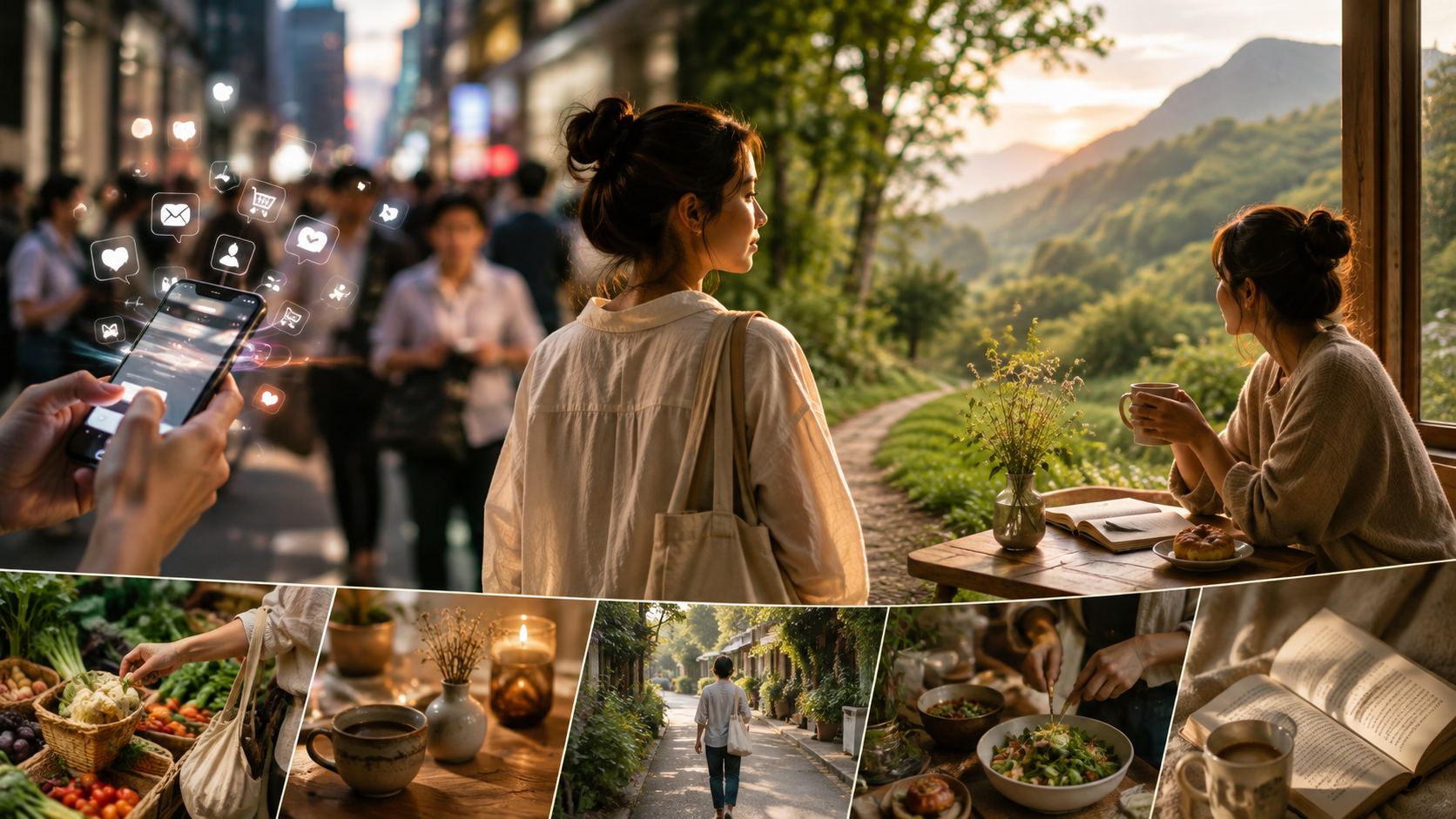
Modern life has never been more convenient. With a few taps, people can order dinner, work from almost anywhere, book a trip, stream entertainment, and communicate with someone on the other side of the world.
Yet despite all that convenience, a growing number of people seem to be looking for something surprisingly different: less.
They are choosing quiet cafés over packed venues, small towns over crowded tourist destinations, home-cooked meals over elaborate dining experiences, and simple weekend plans over schedules filled with activities.
The appeal is not necessarily about rejecting modern life. Instead, it reflects a growing desire to escape the constant stimulation that comes with it.
When Convenience Becomes Overload
Technology has removed countless everyday frustrations, but it has also created an environment where there is almost always something demanding attention.
Notifications arrive throughout the day. Messages can be answered instantly. News updates never stop. Entertainment is available whenever boredom appears. Even free time can become another opportunity to scroll, shop, plan, or consume.
The result is a strange contradiction: people have more ways to save time, yet many feel as though they have less mental space.
Simple experiences offer a break from that cycle.
A walk through a quiet neighborhood does not require much planning. Sitting at a small café does not demand constant stimulation. Cooking a familiar meal can feel satisfying precisely because it is uncomplicated.
The Appeal of Doing Less
There is something psychologically refreshing about activities that have no complicated objective.
A simple afternoon might involve coffee, a book, a short walk, and a conversation with a friend. There is no pressure to maximize the experience or document every moment.
That simplicity can make ordinary activities feel more meaningful.
Instead of asking, “What else can we do?” people are increasingly comfortable asking, “Can we just enjoy this?”
This shift is especially noticeable in travel. Travelers who once focused on checking famous attractions off a list are increasingly interested in slower experiences—wandering local streets, visiting neighborhood markets, spending time in nature, or simply staying somewhere peaceful.
The destination still matters, but the pace matters just as much.
Why Familiar Things Feel Special Again
Another reason simpler experiences are becoming attractive is nostalgia.
Modern life can feel increasingly digital and abstract. Many everyday interactions happen through screens, while purchases arrive without a visit to a store and meals can appear at the door without anyone stepping into a restaurant.
Simple experiences bring back a sense of physical connection.
Buying bread from a neighborhood bakery, browsing a small independent shop, writing something by hand, or eating a meal prepared slowly can feel meaningful because the process itself becomes part of the experience.
These activities are not necessarily better in a practical sense. They simply feel more tangible.
People Are Rethinking What “Good” Looks Like
For years, lifestyle culture often emphasized bigger, faster, newer, and more impressive experiences.
A good vacation meant visiting several destinations. A successful weekend might involve multiple reservations. A popular restaurant needed to be difficult to book and visually impressive.
But the definition of a good experience is changing.
Increasingly, quality can mean having enough time to enjoy something without rushing.
A small restaurant with a few tables may feel more appealing than a huge venue. A quiet cabin can be more attractive than a packed resort. A neighborhood market can provide more memorable moments than another famous landmark.
The experience does not have to look impressive from the outside to feel valuable on the inside.
The Rise of “Low-Effort” Leisure
This does not mean people have stopped enjoying ambitious plans. Concerts, international trips, festivals, and major events still attract millions.
The difference is that people increasingly want balance.
After a demanding workweek, leisure does not always need to become another project.
A “soft” weekend—sleeping in, getting breakfast nearby, taking a walk, watching a movie, or spending time with friends—can feel more restorative than a packed itinerary.
The attraction is partly the absence of pressure.
There is no need to optimize every hour.
Simple Experiences Can Feel More Personal
Highly popular experiences can sometimes become predictable. When thousands of people are visiting the same locations, following the same recommendations, and taking similar photographs, the experience can lose some of its individuality.
Simpler alternatives often leave more room for personal discovery.
A traveler might remember a tiny bookstore, an unexpected conversation, a family-run café, or a quiet street more vividly than a famous attraction surrounded by crowds.
These moments are harder to plan—and that may be exactly why they feel special.
A Search for Attention, Not Just Time
Ultimately, the desire for simpler experiences may have less to do with minimalism and more to do with attention.
People do not necessarily want fewer experiences. They want experiences they can actually be present for.
A quiet meal allows conversation. A walk without constant notifications allows observation. A weekend without an aggressive itinerary allows spontaneity.
In a world where attention has become one of the most valuable commodities, simply being able to focus on one thing can feel luxurious.
The Future May Be More Intentional
Modern life is unlikely to become less connected or less convenient. Technology will continue to make more things faster and easier.
But convenience does not have to determine how people spend their time.
The growing interest in simple experiences suggests that many people are learning to separate efficiency from enjoyment. The fastest option is not always the most satisfying one, and the most impressive experience is not necessarily the most memorable.
Sometimes, the things people remember most are remarkably ordinary.
A slow breakfast. A familiar meal. A quiet street. A conversation that lasts longer than expected.
As modern life becomes increasingly complicated, simplicity may become valuable not because people want to go backward, but because they want to feel present again.
Leave a Reply